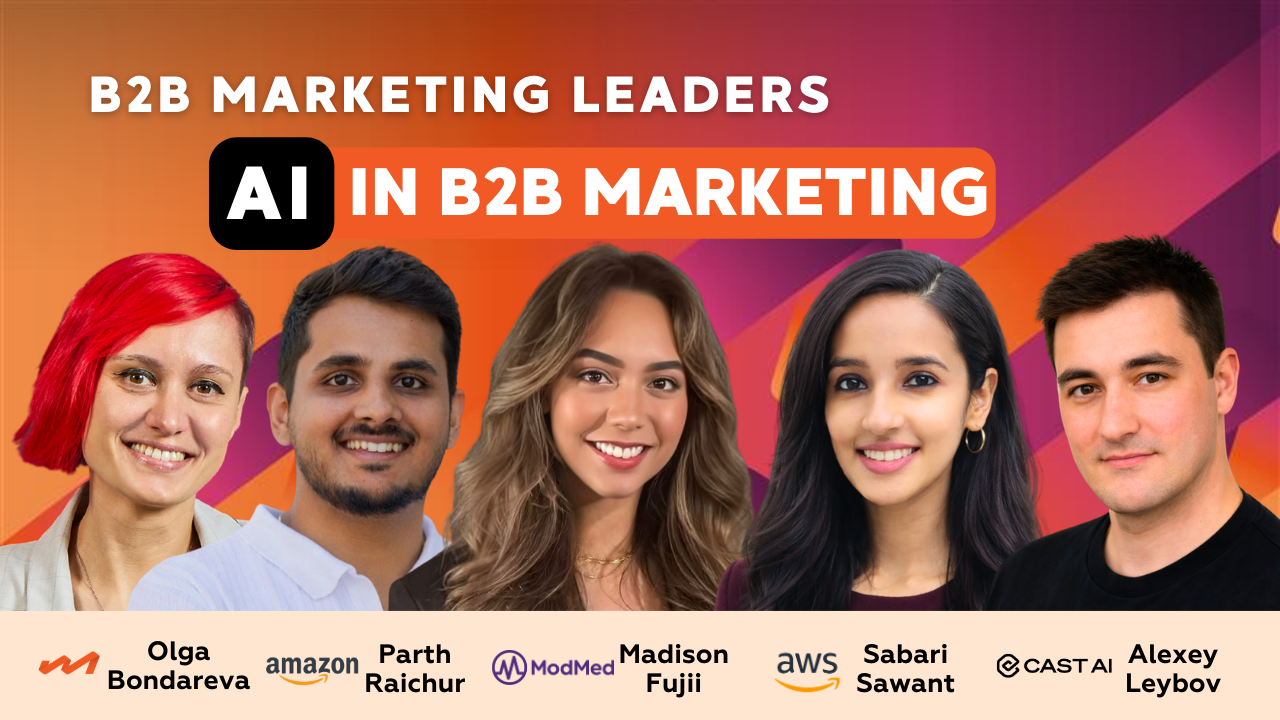
In a recent episode of the B2B Marketing Leaders Podcast, Olga Bondareva, founder of ModumUp, talks about AI in B2B marketing with experts from enterprise companies:
• Sabari Sawant, Product Marketing Manager Kubernetes at Amazon Web Services (AWS)
• Parth Raichur, Performance Marketing Manager at Amazon
• Alexey Leybov, Director of Demand Generation at Cast AI
•Madison Fujii, Digital Marketing Specialist II at ModMed
The Mindset: Optimistic, but Realistic
All of the guests consider themselves techno-realist. Parth put it simply: at Amazon, customer obsession comes first, and AI still has a way to go before it truly understands customers, so it works best as a co-pilot for now. Madison pointed to ongoing risks around hallucinations and the continued importance of human psychology in marketing.
How AI Is Being Used Day-to-Day
The guests grouped their AI usage into a few broad areas.
Parth described completing a competitive benchmarking analysis in 30 to 40 minutes using Amazon QuickSight, Amazon's internal AI ecosystem - a task that previously took a full day - and being able to pull ideal conversion metrics for a campaign without searching for external benchmarks. For multilingual content Parth shared another tool - Translate.ai. It turns a single piece of content into six language versions in under ten minutes.
Sabari uses the same platform at AWS, feeding SEO, platform algorithm, and messaging checklists into an internal AI agent to produce content at scale. She described producing 33 assets across LinkedIn, YouTube, Twitter, and Instagram in a compressed timeline, with a 10x acceleration in output.
Alex groups the use cases into three buckets: research and insights, content creation with full context, and a “chief of staff” function for ops work. Webless personalizes the site experience for each visitor, and Descript cuts video editing and transcripts from hours to minutes.
Madison’s team at ModMed mainly uses ChatGPT and Gemini in Google Workspace for summaries and research, with Jasper.ai coming onboard for brand copy. They also use Drift for demo bookings, agency partners for ChatGPT + SEMrush keyword research.
Risks and Challenges
- Brand voice and compliance. AI can miss the emotional register that matters in B2B. Sabari’s team at AWS skipped AI for a pricing-related feature launch because buyer skepticism made tone too sensitive to automate. Parth flagged the same risk in global comms, where language, tone, and claims need strict human review.
- Data accuracy. Alex shared that after analyzing 11,000 sales calls with AI, his team got a technically correct summary that didn’t match market reality - the conversations were shaped in a specific way. A summary can be right and still wrong to act on. Parth added that measurement drift is a real risk: outputs can sound plausible while diverging from the data.
- Strategy over tools. The AI landscape is noisy. Alex’s take: lead with strategy, not tools - adoption without a clear use case rarely delivers. Madison added that ModMed’s governance-first approach is intentional, especially given HIPAA and healthcare data security requirements.
Training Teams
At Amazon, Parth described a structure where each team has a designated AI influencer who helps colleagues through peer-to-peer sharing, supported by an internal AI/ML university with bookable sessions. Sabari highlighted similar enablement sessions covering prompt engineering, governance, and practical applications.
Madison shared one of the more creative approaches at ModMed: a "12 Days of AI" initiative hosted in a company-wide Slack channel, covering tools, terminology, certifications, and hands-on activities. The company also runs a bi-weekly data literacy book club and an internal AI idea submission program where staff could pitch efficiency improvements.
At CAST AI, with a smaller, engineering-heavy team, Alex said the approach is more organic - learning from what the technical side of the company is already doing.
What Does the Future Look Like?
Answer Engine Optimization - showing up in LLM responses - is becoming a real priority. Sabari is focusing more on how product info shows up inside LLMs, which means content has to be specific, detailed, and intent-based. Alex echoed that the buyer journey is increasingly happening inside AI tools, so brands need to be represented accurately there.
Parth sees ABM personalization at scale as a near-term opportunity and stressed that original POV, strong evidence, and clear positioning matter more as AI content becomes ubiquitous. Madison summed it up well: when AI content is everywhere, authenticity becomes a real differentiator. At ModMed, where the work sits between doctors and patients, that’s not just a brand preference.
You can check out the full episode on the B2B Marketing Leaders Podcast:
Watch on YouTube: https://www.youtube.com/watch?v=QC9WX71_qNI&list=PLGc_Ath6mBNmTQW1cOIiro6VRsg1SzQwU
Listen on Spotify: https://open.spotify.com/episode/54AleioH903bOXS20N7Hqj?si=0f8a03cbb59149a2