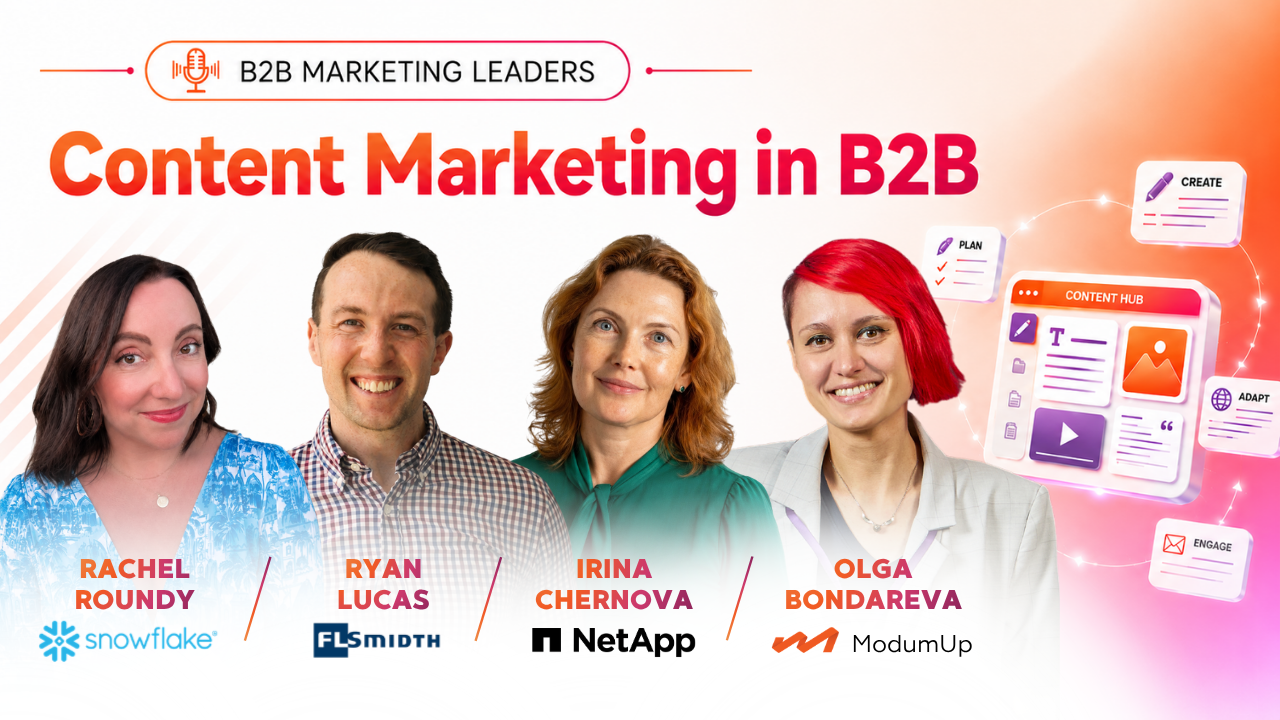
In a recent episode of the B2B Marketing Leaders Podcast, Olga Bondareva, founder of ModumUp, talks about demand generation in B2B with experts from enterprise companies:
- Irina Chernova Demand Marketing Manager EMEA & LATAM at NetApp
- Rachel Roundy, Product Marketing Lead, AI at Snowflake
- Ryan Lucas, Senior Marketing & Communications Manager at FLSmidth
Content as fuel, not filler
Rachel Roundy describes content as the fuel that keeps the marketing engine running. Every channel depends on it, and low-quality content can slow the whole system down.
At Intel, she helped shift the focus away from brand-heavy messaging and acronyms. Instead, the team made the buyer the hero and focused on practical, actionable guidance. That change contributed to strong results: social engagement roughly doubled, the nurture database grew nearly threefold, and webinar conversion reached around 20%.
Irina Chernova at NetApp sees content as anything that helps move a buyer forward, from a leadership keynote to a PDF. Ryan Lucas at FLSmidth adds the sales perspective: external blogs and webinars matter, but content that helps move an opportunity closer to conversion is often what receives the most internal support.
Always-on and localized
Based on Irina Chernova’s experience at NetApp, local-language content often performs better than global English-language assets. Webinar recordings delivered in local languages have worked particularly well across both internal and external platforms.
In markets such as Germany, the most effective programs tend to run consistently over time rather than relying on one-off campaign bursts.
Rachel Roundy describes always-on content as the cake and campaigns as the frosting. She also piloted a webinar-in-a-box model for regional teams. The central team provided the core messaging and slides, while local subject-matter experts delivered the content in their own language, rather than simply adding subtitles to a global presentation.
Measure what helps buyers move forward
Rachel Roundy separates KPIs into two groups: program-level outcomes, such as pipeline and revenue, and tactical indicators, such as views and scroll depth, which teams can use to improve content quickly.
She also questions the value of requests to “make something go viral.” Millions of impressions have limited value when they do not come from the right audience or cannot be translated into a repeatable approach.
Ryan Lucas at FLSmidth still reports impressions to stakeholders, but he also relies on direct feedback from sales. Does the asset help sales teams in real conversations, or is its practical value limited? These conversations have helped the team reduce low-impact work.
Irina Chernova notes that ABM-style measurement can show how specific documents and customer stories influence priority accounts. At the same time, conversations with sales and customers often provide context that dashboards cannot capture.
Build on what already exists
Rachel Roundy describes the challenge of one-off content ideas that appear outside the agreed strategy. Even strong ideas need to be assessed against the audience, business objective, and broader content plan.
Ryan Lucas prefers publishing when the work is strong enough and then improving it based on feedback, rather than waiting for every stakeholder to agree on a perfect final version.
Irina Chernova highlights another common enterprise challenge: teams often recreate assets that already exist elsewhere in the organization, including analyst relations, events, customer references, and other content teams. In many cases, finding and adapting existing material is more effective than starting from scratch.
AI as a thinking partner, not just a writing tool
Rachel Roundy believes that using AI only for copywriting leaves much of its potential untapped. More valuable applications can include custom GPTs built around specific personas and supported by approved customer journey data, product information, sales insights, and social listening.
She also sees potential in modular, pre-approved content blocks that teams can combine and adapt for different assets and audiences.
Irina Chernova at NetApp uses AI to create early drafts for short-form content and localization when speed is important. Human experts then review and refine the output.
Ryan Lucas at FLSmidth uses approved stakeholder call transcripts to develop initial blog drafts. He also uses AI for brainstorming and tagline development.
The common takeaway is that AI can help teams work faster, but human judgment and a natural, audience-focused voice still make B2B content stand out. Buyers are people, not just accounts.
You can check out the full episode on the B2B Marketing Leaders Podcast:
Watch on YouTube: https://youtu.be/HqyYDDV4-fI
Listen on Spotify: https://open.spotify.com/episode/3dZyXaPuduXgUacZliuPZt